
Project Sunrise
In September, I analysed Trump’s 20-point plan for Gaza and identified the architecture: conditional finance, enforced through external oversight, operationalised via six technical rails. The template employed in Ukraine was visible, but the benchmarks were pending. The blended finance mechanism was implicit — referenced through ‘public-private partnerships’ requirements, but not yet codified.
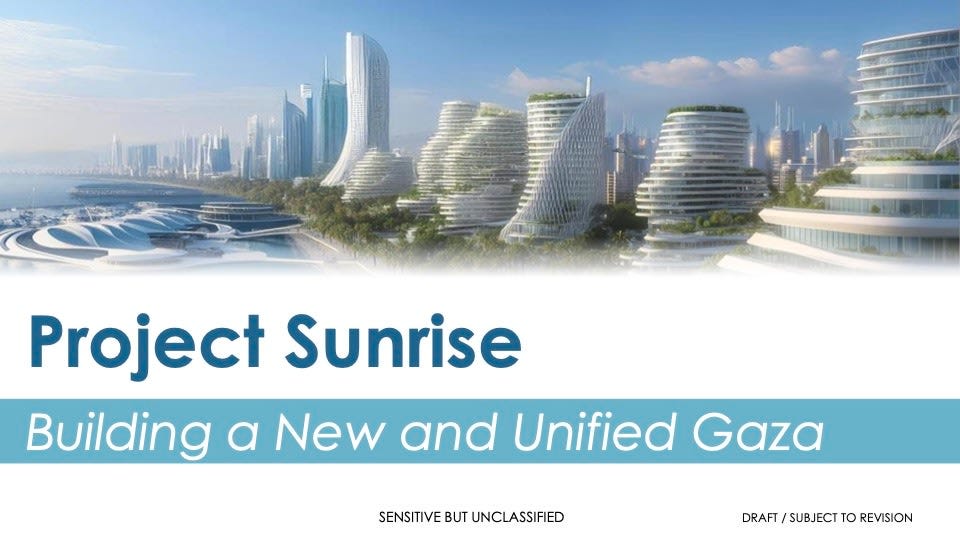
Three months later, Project Sunrise has made explicit what was then inference. The Wall Street Journal’s reporting1 matters precisely because it contains the numbers, the sequencing, and the monetisation clauses that moves this analysis from pattern-recognition to documentation.
Find me on Telegram: https://t.me/escapekey
Find me on Substack: https://escapekey.substack.com
Find me on Ghost: https://the-price-of-freedom-is-eternal-vigilance.ghost.io
Bitcoin 33ZTTSBND1Pv3YCFUk2NpkCEQmNFopxj5C
Ethereum 0x1fe599E8b580bab6DDD9Fa502CcE3330d033c63c
The Architecture Confirmed
The 32-page PowerPoint presentation — developed by Jared Kushner, Steve Witkoff, and senior White House aide Josh Gruenbaum over 45 days2 — is an exercise in raising capital; it’s not a policy document. It confirms the financial architecture (anchor commitments, blended finance, monetisation schedule) but doesn’t develop the operational rails discussed in September — digital ID requirements, accreditation, data streams, audit protocols, leading to financial actuation. Yet, those remain visible in active UN tenders and existing biometric systems, awaiting formalisation once capital is committed. What this presentation does confirm is the destination: the same taxpayer-funded cash bonanza the EU has structured for Ukraine3, to be capitalised on by the private ‘partners’.
The total cost: $112.1 billion over ten years. Just under $60 billion comes through taxpayer-funded grants ($41.9 billion) and new debt ($15.2 billion), with the US offering to ‘anchor’ 20% or more of the support. The World Bank (similarly funded by largely Western taxpayers) would play a financing role. Costs would taper as Gaza is promised to ‘make money’ entering the second decade, with 70% of the coastline monetised beginning in year 10 — projected to generate over $55 billion in long-run investment returns.
This is blended finance laid bare.
Blended Finance
Blended finance is marketed as using public funds to ‘de-risk’ private investment, thereby mobilising capital at scale for development. In short: public guarantees socialise the downside, which attracts private capital, which then privatises the upside. Taxpayers absorb losses; investors capture gains; incidentally also the mechanism employed in context of ‘conservation finance’ and the Global Environment Facility: Lemon Socialism 2.04.
Project Sunrise makes this sequencing explicit. The US commits to anchoring the reconstruction with grants and debt guarantees during the high-risk first decade. Gulf sovereign wealth funds, Turkish capital, and private investors are courted as partners. The revenue model depends on coastal monetisation — transforming Gaza’s shoreline into assets that produce returns once the publicly-funded reconstruction has absorbed the initial risk.
Three timelines structure the plan, and keeping them distinct matters:
- First, the ten-year budget window: $112.1 billion in costs, with public anchor financing front-loaded.
- Second, the 20-plus-year roadmap: reconstruction proceeds in four geographic phases (Rafah, Khan Younis, centre camps, Gaza City), with coastline monetisation beginning in year ten and investor returns promised to flow thereafter.
- Third, the peace-process phasing: Phase 1 (hostage completion) → Phase 2 (demilitarisation, Israeli withdrawal) → Phase 3 (reconstruction begins). The multi-year rebuild only starts after all three phases complete.
The interaction is critical: the peace-process gates must clear before the budget clock even starts. Conditional periods compound rather than run concurrently.
The extraction logic follows from sequencing. Public money flows during the dangerous, uncertain reconstruction years. Private capture begins precisely when the territory becomes profitable — through assets built with publicly-guaranteed capital. This isn’t partnership so much as sequenced risk-transfer with development branding. For all its glossy reputation, this is what blended finance ultimately is about: private capitalisation of taxpayer funding.
But what makes Gaza’s application notable is who is positioned near the extraction layer. Kushner founded Affinity Partners, a Miami-based private-equity firm that has raised more than $3.5 billion5, much of it from the same Middle Eastern sovereign wealth funds now being courted as Project Sunrise donors. The WSJ reports he has pursued similar luxury coastal development on Sazan Island in Albania. The plan doesn’t name Affinity as a direct beneficiary — but the structural conflict of interest is evident: the same actor shaping the reconstruction framework operates a fund capitalised by the prospective investors, in sectors (real estate, infrastructure, Middle Eastern ventures) that align with the plan’s commercial opportunities.
The Pilot Already Running
Project Sunrise isn’t introducing blended finance to Palestine — it’s scaling a model that’s been operational since 2015.
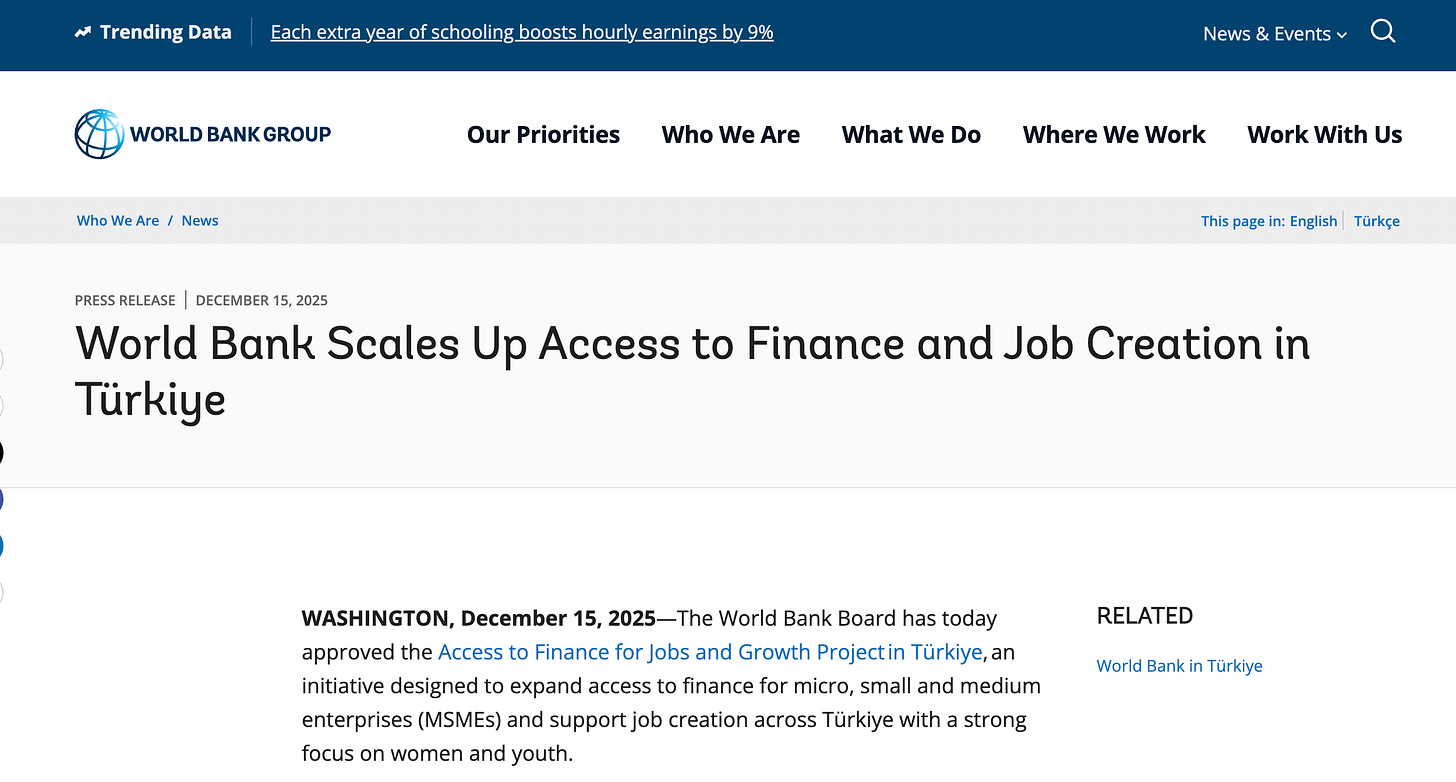
The World Bank’s Finance for Jobs6 (F4J) programme, implemented by DAI on behalf of the Palestinian Ministry of Finance, established the template. It launched the first World Bank Development Impact Bond7 (DIB) worldwide — explicitly designed as ‘an innovative instrument that blends impact investing, results-based financing, and public-private partnership’. The core assumption, per World Bank documentation: ‘many projects in Palestine are commercially viable, but external risks make them too risky to finance’.
Public money de-risks; private capital enters; results-based payments flow8.
The mechanics are identical to Project Sunrise’s structure. F4J has mobilised $47.8 million in private capital since 20189, financed by impact investors including the EBRD, Palestine Investment Fund, and FMO. It started at $5 million in 2015, then scaled repeatedly through additional financing rounds — each expansion justified by ‘positive results’ from the previous phase.
The programme was explicitly designed ‘to pilot new approaches and generate lessons learned, with the objective to scale up the instruments that deliver results’.
Project Sunrise is the scale-up. The $5 million DIB pilot becomes the $112 billion coastal monetisation plan. The same World Bank that backstopped F4J would ‘play a financing role’ in reconstruction. The same blended finance logic — public guarantees socialise downside, private capital privatises upside — operates at three orders of magnitude greater scale.
The institutional learning is visible: F4J proved the instruments work in Palestine’s ‘fragile, conflict-affected’ context. Project Sunrise applies those instruments to the post-destruction landscape, where people are desperate and leverage is therefore total.
Conditional Sovereignty
The conditionality structure follows Ukraine’s template. The presentation acknowledges on the second page — bold and in red — that Gaza’s reconstruction depends on Hamas ‘to demilitarise and decommission all weapons and tunnels’. Finance is gated by security compliance assessed by external parties.
But the conditionality extends beyond security. Each phase creates a gate controlled externally: Phase 1 requires hostage completion; Phase 2 requires demilitarisation and Israeli withdrawal; Phase 3 requires security certification. Only then does reconstruction begin — meaning the conditional period extends well beyond a decade before any meaningful autonomy could materialise.
‘New Rafah’ — described as Gaza’s future ‘seat of governance’ — will be designed and built according to external specifications. This is governance installation, not restoration. The critical question isn’t whether postwar rebuilds require administrative capacity — they do — but who designs that capacity, who controls it during the ‘transitional’ period, and under what conditions authority transfers.
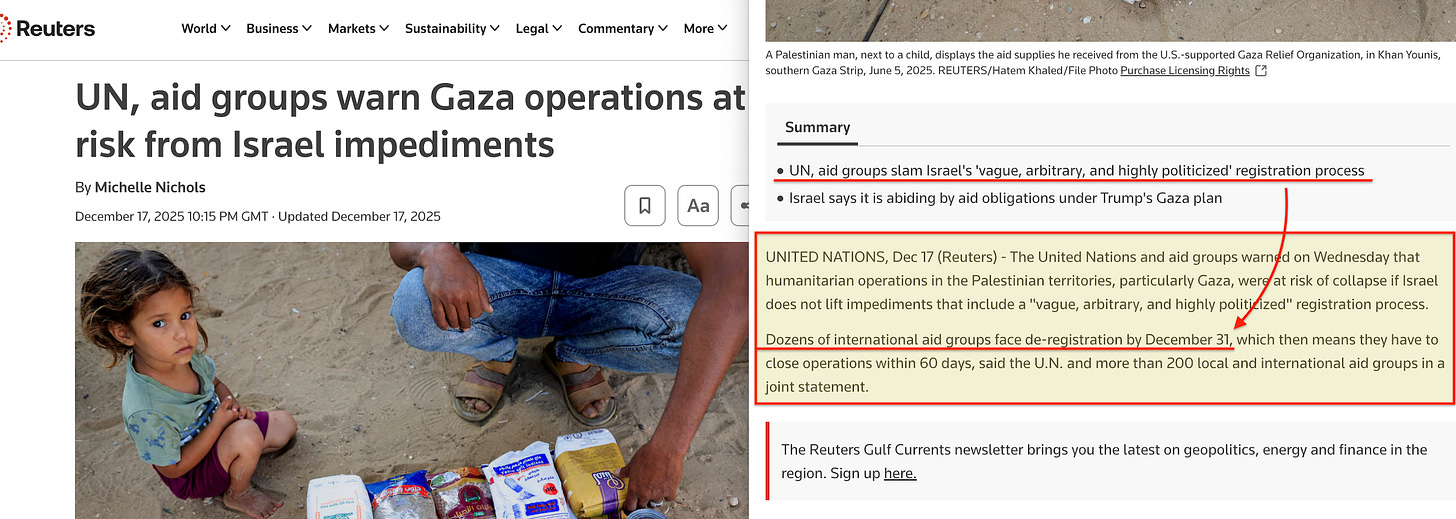
The reconstruction is pitched as internationally governed and substantially US-funded — yet Israel currently controls NGO registration10, determining which international organisations can operate in Gaza at all. The institutional vocabulary says ‘external oversight’; the administrative reality says otherwise.
If Israel controls which organisations can operate in Gaza now, then organisations that document human rights violations can be excluded; organisations aligned with Israeli preferences get approved; the pool of future reconstruction bidders is pre-filtered; and accountability-oriented actors never reach the starting line.
The ‘Board of Peace’11 and international authority framing provides Western legitimacy for the funding ask. But the actual gatekeeping — who enters, who operates, who stays — runs through Israeli administrative control. The international vocabulary is the wrapper; the registration mechanism is the control layer.
And critically: the party that caused the destruction gets to approve who participates in reconstruction, using funds provided by third parties, with returns flowing to fourth parties. There’s no accountability. The funder has no control; the controller bears no cost; the profiteer takes no risk. That’s not a peace plan. It’s an extraction architecture with distributed liability — designed so that no single party appears responsible for the whole.
The WSJ reports that Kushner, Witkoff, and Gruenbaum ‘received input from Israeli officials, people in the private sector and contractors’. What’s notable is what isn’t mentioned: Palestinian Authority consultation, Palestinian civil society engagement, or representation of the 2 million people whose future is being designed in these slides.
The presentation ‘does not specify where precisely the 2 million displaced Palestinians would live during reconstruction’. The omission speaks louder than any inclusion could.
The Legal Charter
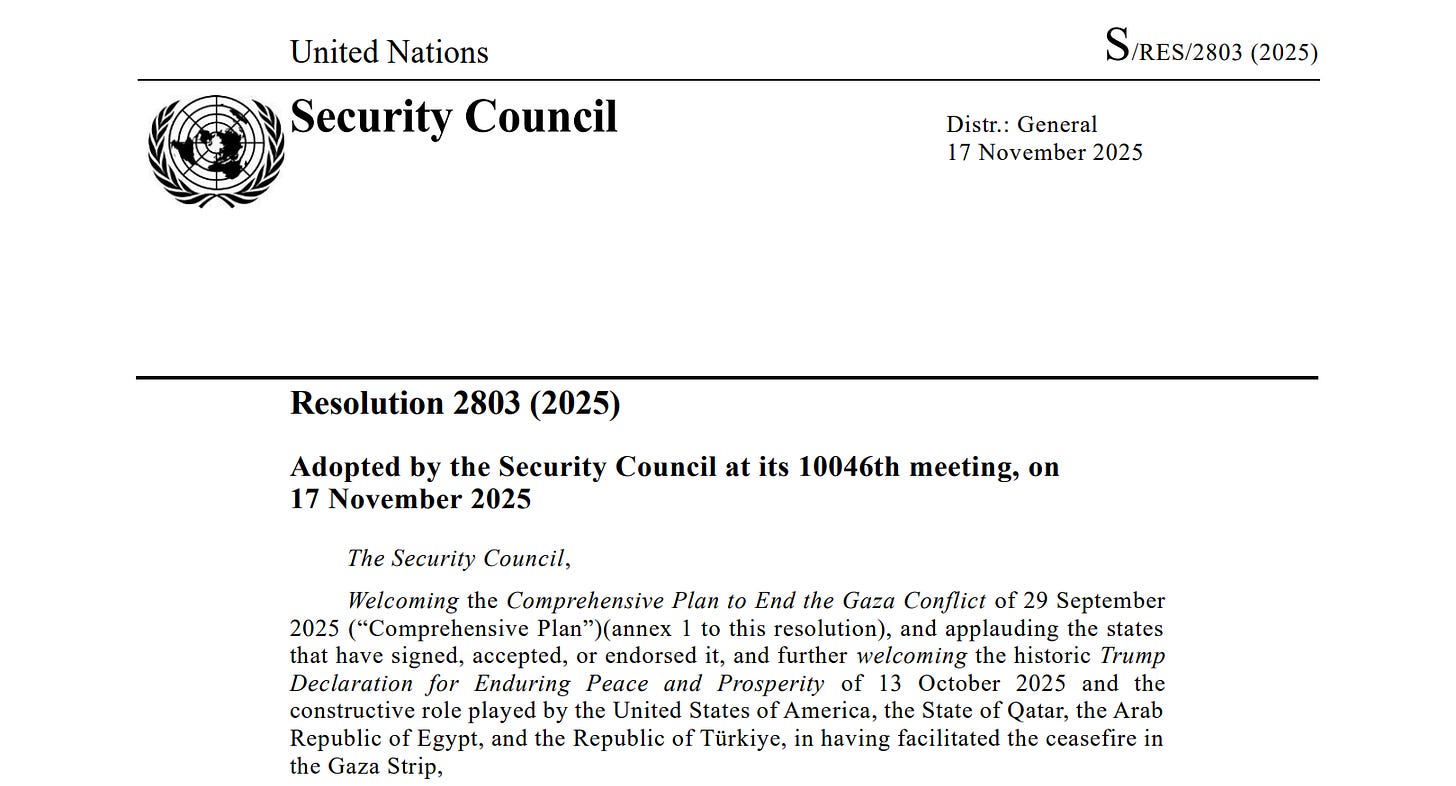
Project Sunrise is the pitch deck. UN Security Council Resolution 280312, adopted on 17 November 2025, is the legal charter that makes it enforceable.
The resolution, passed 13-0 with Russia and China abstaining, endorses Trump’s ‘Comprehensive Plan to End the Gaza Conflict’ and establishes the governance architecture in international law. The Board of Peace becomes a ‘transitional administration with international legal personality’ — meaning it has sovereign authority over Gaza, on paper. Trump chairs it. But the resolution also authorises an International Stabilisation Force13 (ISF) to handle security, demilitarisation, and weapons decommissioning, with a mandate to ‘use all necessary measures’.
But sovereign authority means little when Israel still controls NGO accreditation — determining which organisations can operate in Gaza at all. The Board has legal personality; Israel has the registration mechanism. Once again: the international vocabulary is the wrapper; Israeli administrative control is the actual gatekeeping layer.
The conditional sovereignty structure is now codified. Palestinian statehood is explicitly gated: only ‘after the PA reform program is faithfully carried out and Gaza redevelopment has advanced’ may ‘conditions finally be in place for a credible pathway to Palestinian self-determination and statehood’. The word is ‘pathway’ — not statehood itself, but the possibility of a path toward it, subject to external certification. IDF withdrawal is tied to ‘standards, milestones and timeframes linked to demilitarization’ — assessed by the Board, not by Palestinians.
The mandate runs until 31 December 2027, ‘subject to further Council action’ — meaning it can be renewed indefinitely. Six-monthly progress reports to the Security Council create the audit layer: compliance tracking built into the legal structure.
What the resolution doesn’t mention is as significant as what it does. There is no reference to the ICC arrest warrants against Netanyahu and Galant14, no mention of the ICJ advisory opinion declaring Israel’s occupation unlawful15, no transitional justice mechanism, no accountability framework of any kind. The party responsible for the destruction faces no legal reckoning in the reconstruction charter.
The responses were telling. Russia’s ambassador warned the arrangement is ‘reminiscent of colonial practices’16. Hamas called it ‘replacing Israeli occupation with foreign guardianship’17. UN Special Rapporteur Francesca Albanese said it ‘runs counter to the Palestinian right to self-determination’ and ‘risks legitimating ongoing mass violence’18. Legal scholars at the American Society of International Law compared it to the UN administrations in Kosovo and East Timor — ‘fourth-generation peacekeeping’ with ‘colonial connotations’19.
The Template Scales
Analysts at the Arab Center Washington DC characterise Project Sunrise as a blueprint for dispossession rather than reconstruction20 — extraction dressed in humanitarian vocabulary. That reading is correct as far as it goes, but the mechanics run deeper than the moral framing suggests.
Ukraine served as the pilot: conditional finance through the EU Facility, 69 reforms tracked by 130 indicators, disbursed in scheduled tranches, monitored via public scoreboard21. Gaza is the second application — same conditional sovereignty architecture, same blended finance logic, different legitimating frame.
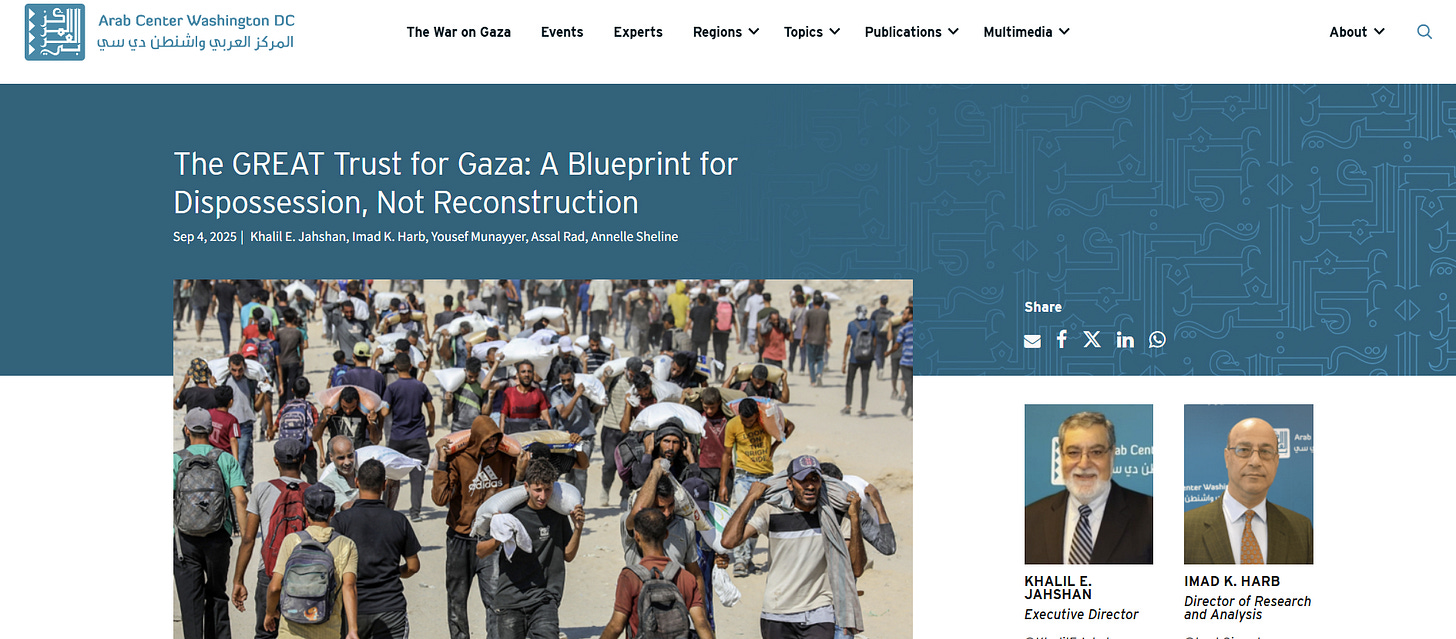
The GREAT Trust proposal22 that preceded Project Sunrise is instructive. Devised by Israelis supportive of a ‘controversial aid-distribution plan’ with Boston Consulting Group handling the financial modelling, it included provisions where Palestinians could ‘voluntarily relocate’ while the US would ‘initially help administer’ the territory. Project Sunrise appears to be GREAT Trust refined for public presentation — the population-management language softened, but the 2 million displaced still unaccounted for.
Steven Cook of the Council on Foreign Relations23 provides the clearest diagnosis: ‘If you say something enough people will believe it so if they say they aren’t nation-building, they hope people will believe it. But they are nation-building’.
The denial is strategic. ‘Nation-building’ carries political baggage from Iraq and Afghanistan, so the language shifts to ‘reconstruction’, ‘development’, ‘peace plan’. But the operational architecture — external authority, conditional finance, governance installation, commercial capture — follows the same pattern.
The Distribution of Risk and Gain
The available documentation reveals Project Sunrise not as a neutral development proposal but as an operational blueprint for externally imposed, condition-based governance — a Western-backed, taxpayer-funded ‘trisectoral network‘ where public money anchors private investment, civil society organisations deliver services, and Israel administers which CSOs can operate at all.
The plan socialises risk and cost while privatising potential future gains:
Risk distribution:
- Political risk falls on international actors — anchor commitments expose them to legitimacy costs if the project fails or its nature becomes undeniable.
- Financial risk falls on taxpayers — grants, guarantees, and front-loaded reconstruction costs are publicly funded.
- Human cost falls on Gazans — displacement, unspecified relocation during construction, the accountability void, and subordination to external governance for a generation or more.
Gain distribution:
- Investment returns flow to private investors — coastline monetisation, projected $55 billion in long-run returns.
- Geopolitical positioning accrues to regional actors — normalisation benefits, security arrangements, influence over a strategically located territory.
- Commercial opportunity concentrates among PE firms, contractors, and consultancies positioned at the extraction layer.
The trisectoral architecture — public, private, civil society — is marketed as balanced governance. But the balance is illusory. The Western taxpayer pays; the private sector profits; and the civil society layer — which might otherwise provide accountability — operates only at the discretion of Israeli registration authorities.
The plan’s failure to engage Palestinians as sovereign agents is another fundamental flaw. A framework that treats a population as objects to be administered, relocated, and eventually replaced by a different demographic cannot claim legitimacy, regardless of the humanitarian vocabulary it deploys.
The PowerPoint comes complete with cost tables, monetisation schedules, and returns projections. The documentation is public. The pattern is not inference.
What remains is whether the humanitarian vocabulary can survive contact with the dispossession it enables, and whether anyone with standing will name what is plainly visible in the slides: a capital raise dressed as reconstruction, serving investors who bear no risk, a population granted no voice, and an accountability layer vetted by the party that created the destruction.
Appendix: September Inference, December Confirmation
- Financial Architecture: Conditional, taxpayer-anchored blended finance → Plan cost is $112.1B over 10 years, with the U.S. committing ~20% as ‘anchor’. World Bank to be involved. Confirmed24.
- Monetisation & Extraction Logic: Public de-risking for private, long-term coastal capture → Plan to monetise 70% of the coastline starting in Year 10, projected to generate over $55B in returns. Confirmed.
- Conditional Sovereignty: Reconstruction gated by security/political compliance → A red-box warning states reconstruction depends on Hamas demilitarisation. Phases require hostage return and Israeli withdrawal. Confirmed.
- External Governance: Installation of externally designed administrative capacity → ‘New Rafah’ is designed as the future ‘seat of governance’ with detailed external specs. An international Board of Peace is planned. Confirmed.
- Absence of Palestinian Agency: Population treated as objects, not sovereign agents → Plan does not specify where 2 million displaced Palestinians will live during rebuild. No mention of PA or civil society consultation in reports. Confirmed.
- Active Positioning of Private Actors: Firms positioning at the ‘extraction layer’ → U.S. contractors are actively vying for roles. One proposal envisioned a ‘Master Contractor’ grossing $1.7B annually on trucking fees. Confirmed25.
- Structural Economic Control: Use of financial levers to enforce dependency → Separate analysis details Israeli control over Palestinian monetary system (banking waivers, tax revenues), creating ‘permanent precarity’. Context confirmed26.
Some observers point out that the plan needs a stable, peaceful Gaza to attract investors, but right now Gaza is broke and Israel controls the money through controlling the NGO accreditation process. How can you sell a beach resort when the territory is in ruins?
But this isn’t actually a contradiction — it’s the point. You can’t dictate terms to a country that’s doing fine on its own. The desperation is what makes the conditions enforceable. If Gaza weren’t broken, there’d be no leverage to impose external control.
The crisis isn’t an obstacle to the plan; it’s what makes the plan possible.
https://www.jpost.com/middle-east/article-880819
https://www.npr.org/sections/money/2009/03/lemon_socialism_anyone.html
https://documents.worldbank.org/en/publication/documents-reports/documentdetail/506661565076421668
https://unsdg.un.org/resources/unsdg-results-based-management-handbook
https://press.un.org/en/2025/sc16225.doc.htm
https://docs.un.org/en/s/res/2803(2025)
https://www.aljazeera.com/news/2025/11/18/what-is-the-international-stabilisation-force-for-gaza
https://news.un.org/en/story/2024/11/1157286
https://www.icj-cij.org/node/204176
https://www.asil.org/insights/volume/29/issue/16
https://ec.europa.eu/commission/presscorner/detail/en/ip_24_1982
https://www.washingtonpost.com/documents/f86dd56a-de7f-4943-af4a-84819111b727.pdf
https://www.cfr.org/expert/steven-cook
https://www.theguardian.com/us-news/2025/dec/14/gaza-rebuild-us-contractors
https://www.lawfaremedia.org/article/why-gaza-s-aid-effort-will-fail-without-cash
